

Description
What is Kisspeptin?
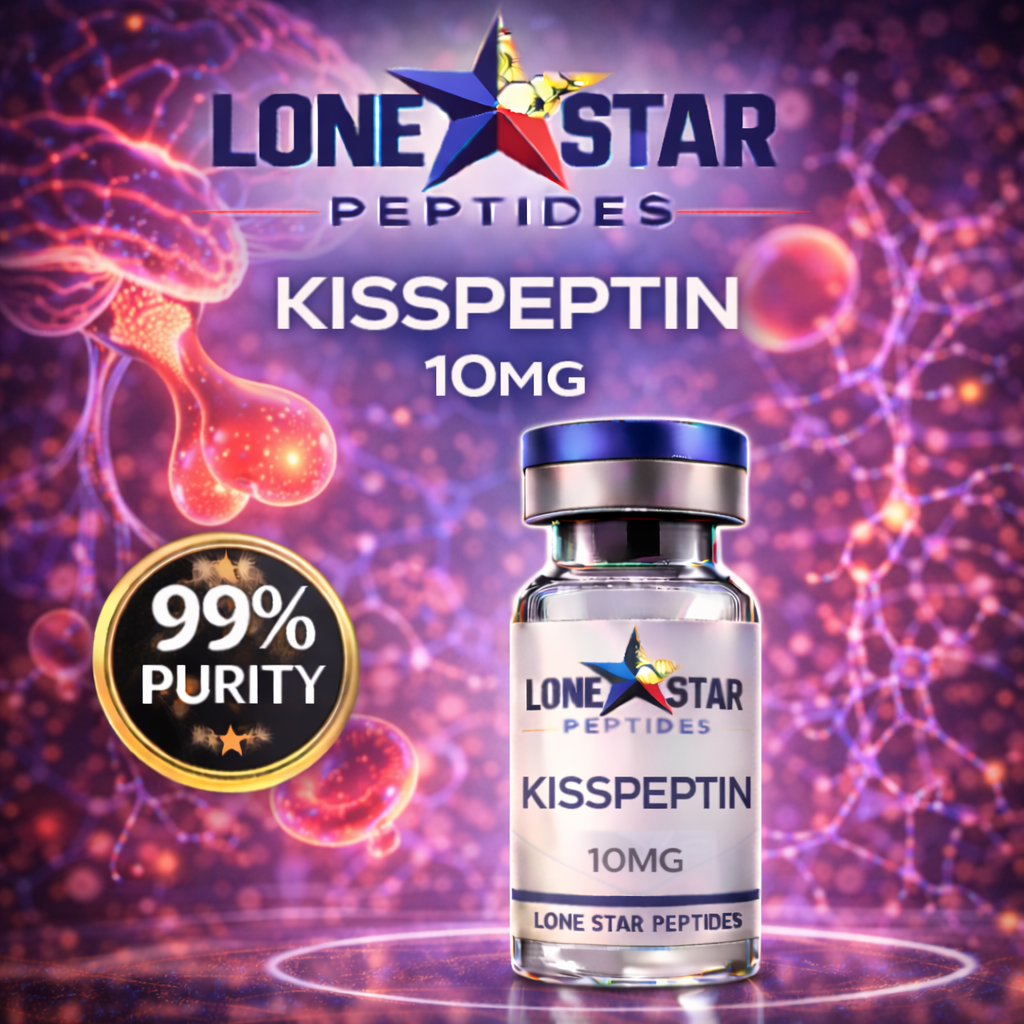
Kisspeptin refers to the family of peptides encoded by the KISS1 gene, with the C‑terminal 10‑residue fragment (kisspeptin‑10, KP‑10) carrying most of the receptor‑activating potency. Kisspeptin‑GPR54 signaling in hypothalamic ARC and AVPV nuclei is the master integrator of GnRH pulsatile output, and its discovery (Seminara 2003, de Roux 2003) transformed understanding of pubertal initiation and reproductive endocrinology.
Mechanism of Action
- Agonist at the GPR54 (Kiss1R) G‑protein‑coupled receptor on hypothalamic GnRH neurons
- Triggers pulsatile GnRH release, driving downstream LH and FSH secretion from the anterior pituitary
- Integrates metabolic, gonadal, and environmental signals to regulate the HPG axis
- Also expressed in placenta, gonads, and metastasis‑suppressor context in cancer biology (distinct from reproductive role)
Compound Properties
- KP‑10 sequence: Tyr‑Asn‑Trp‑Asn‑Ser‑Phe‑Gly‑Leu‑Arg‑Phe‑NH₂ (last 10 residues of kisspeptin‑54)
- Molecular formula (KP‑10): C63H83N17O14
- Molecular weight: ~1302.4 g/mol
- Form: Lyophilized powder
- Unit size: 10 mg / vial
- Source: Solid‑phase peptide synthesis; ≥98% purity by HPLC
Research‑Reference Dosing
Published research‑reference ranges in clinical literature:
- Seminara et al., NEJM (2003); de Roux et al., PNAS (2003): foundational GPR54 genetics and reproductive phenotypes.
- Jayasena et al., JCI, JCEM (2011–2017): kisspeptin‑54 and KP‑10 in women with hypothalamic amenorrhea and IVF stimulation.
- Abbara et al., Lancet (2014); JCEM (2017): KP‑54 in IVF trigger protocols as an alternative to hCG/GnRHa.
Research Findings
- Reliable acute stimulation of LH secretion in healthy and hypogonadal humans (Jayasena 2011)
- Successful oocyte maturation trigger in IVF with markedly reduced ovarian hyperstimulation syndrome risk vs. hCG (Abbara 2014)
- Diagnostic utility in differentiating hypothalamic vs. pituitary reproductive axis disorders
Known Side Effects Reported in Research/Trials
- Generally very well tolerated across published cohorts
- Mild injection‑site reactions
- Transient flushing or headache
- Tachyphylaxis with continuous (non‑pulsatile) administration — pulsatile dosing is typical in research protocols
Storage & Handling
- Lyophilized (unreconstituted) vials: store at −20°C long‑term; short‑term 2–8°C acceptable.
- After reconstitution with bacteriostatic or sterile water: store at 2–8°C; use within 14–28 days per standard peptide stability guidance.
- Protect from light, heat, and repeated freeze‑thaw cycles. Handle in a sterile laboratory environment.
Certificate of Analysis
A Certificate of Analysis (COA) confirming identity and purity by HPLC / MS is available upon request. Contact Lonestar Peptides for lot‑specific documentation.
Summaries reference peer‑reviewed preclinical and clinical literature available as of early 2025. Newer findings may not be reflected. Researchers should consult current literature and conduct their own due diligence. Lonestar Peptides makes no claim of therapeutic benefit.