


Description
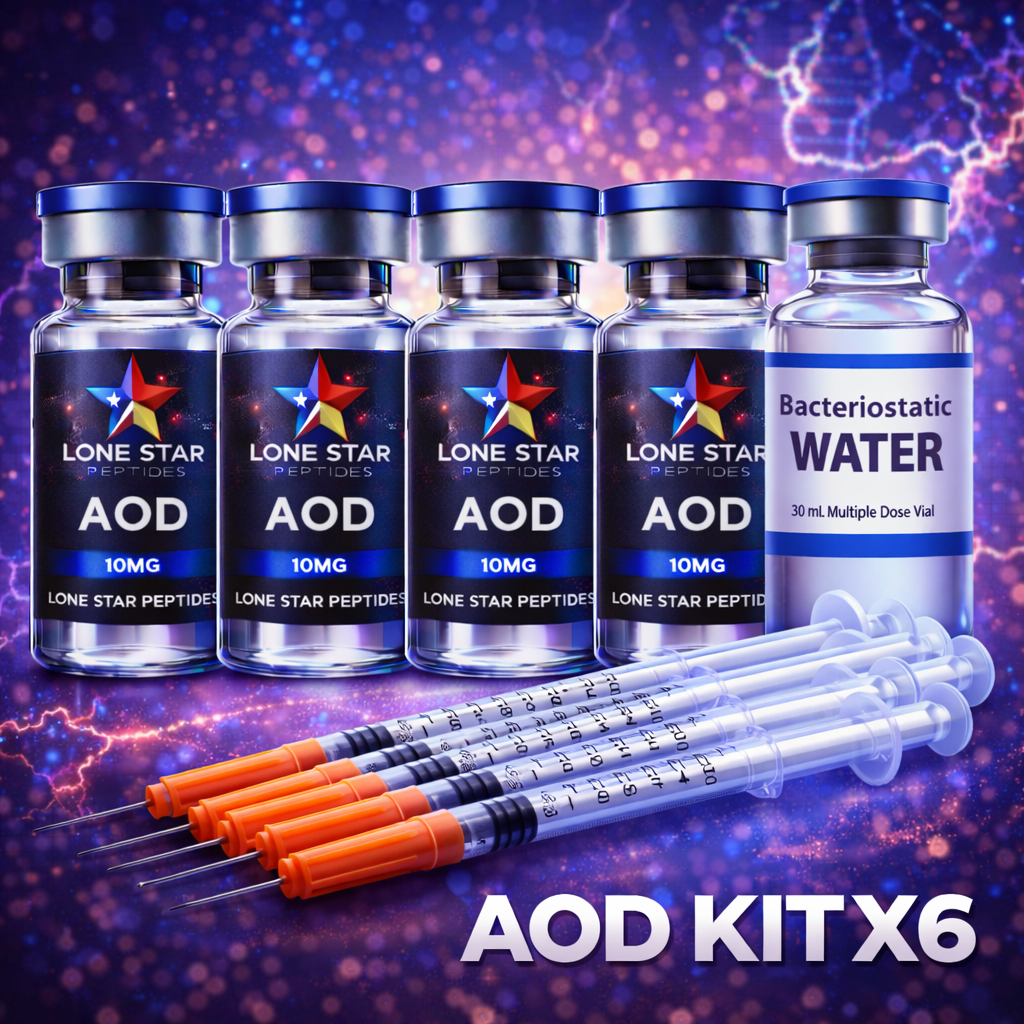
What is the AOD Kit x6?
The AOD Kit is a bulk research pack of AOD-9604 (Anti-Obesity Drug 9604), a synthetic analog of the C-terminal fragment of human growth hormone corresponding to residues 176-191 (Tyr-hGH 177-191). Each kit ships as either 6 × 5 mg vials or 3 × 10 mg vials of lyophilized (freeze-dried) powder — a total of 30 mg, sufficient for approximately 30 days of research-reference work at a 1 mg/day protocol. For the single-vial reference product and detailed monograph, see AOD-9604 (5mg / 10mg).
Mechanism of Action (Research Context)
AOD-9604 was developed in the 1990s at Monash University as a short fragment of growth hormone designed to retain the lipolytic (fat-mobilizing) activity of full-length hGH while omitting the growth-promoting and insulin-antagonizing regions. Preclinical research describes:
- Stimulation of lipolysis in adipocytes — believed to act via β3-adrenergic receptor pathways rather than hGH receptors (Ng & Bornstein, 1998; Heffernan et al., 2001).
- Inhibition of lipogenesis — reduced accumulation of new fat in cultured adipocyte models.
- No measurable effect on serum IGF-1 in rodent and limited human studies, distinguishing it pharmacologically from full-length hGH.
Compound Properties (per vial)
- Compound: AOD-9604 (hGH Fragment 176-191, Tyr-)
- Sequence: H-Tyr-Leu-Arg-Ile-Val-Gln-Cys-Arg-Ser-Val-Glu-Gly-Ser-Cys-Gly-Phe-OH (disulfide bond Cys7-Cys14)
- Molecular Formula: C78H123N23O23S2
- Molecular Weight: ~1817.1 g/mol
- CAS Number: 221231-10-3
- Form: Lyophilized (freeze-dried) white powder
- Purity: ≥98% (HPLC)
- Kit Contents: 6 × 5 mg vials or 3 × 10 mg vials (total 30 mg)
- Source: U.S.-based synthesis, third-party HPLC/MS tested
Research-Reference Dosing
Published investigational protocols in obese adult subjects have typically used 1 mg/day subcutaneous injection over 12-week study periods (Heffernan et al., Eur J Pharmacol, 2001; Ng et al., 2000). The 30 mg total kit quantity is consistent with a ~30-day reference protocol at this reference dose. Dose selection, titration, and duration are determined by the qualified researcher based on the study design; this listing is not a dosing recommendation for human use.
Lyophilized material is typically reconstituted with bacteriostatic water for injection for laboratory reference work. Reconstituted solution is stored refrigerated and used within 14-28 days per stability literature for short peptides.
Research Findings
- Phase 2b human obesity trial (Metabolic Pharmaceuticals, 2007): A 12-week randomized trial in ~500 obese adults reported modest fat-mass reduction vs. placebo at 1 mg/day SC, with a safety profile comparable to placebo. Full peer-reviewed publication remains limited; summary data are available in company filings.
- Lipolysis / anti-lipogenic activity in vitro: Heffernan et al. (Endocrinology, 2001) documented increased lipolysis and reduced lipogenesis in 3T3-L1 adipocytes and mouse models.
- Cartilage research: Exploratory work (Kwon et al., 2015) has examined AOD-9604 co-administration with hyaluronic acid in animal osteoarthritis models, suggesting chondroprotective signals — independent of the lipolytic pathway.
- IGF-1 neutrality: Multiple studies report that AOD-9604 does not elevate IGF-1, consistent with its design to separate lipolytic from growth-promoting activity.
Note: Human efficacy data for AOD-9604 is limited, and the compound did not advance to regulatory approval as an obesity therapeutic. Claims of dramatic weight loss in marketing material are not supported by peer-reviewed literature. Research beyond early 2025 is not reflected here.
Known Side Effects Reported in Research / Trials
- Injection-site reactions (redness, mild irritation) — most common finding in the Phase 2b trial.
- Mild headache and fatigue reported at low rates, comparable to placebo.
- No clinically significant changes in fasting glucose, insulin, or IGF-1 in the reported trials.
- Safety beyond the ~12-week trial window and in combination with other compounds is not well characterized in published literature.
Storage & Handling
- Unopened lyophilized vials: store refrigerated at 2-8 °C; long-term storage at −20 °C recommended. Protect from light.
- After reconstitution: refrigerate at 2-8 °C; use within 14-28 days per standard peptide stability guidance.
- Do not freeze-thaw reconstituted material repeatedly.
Certificate of Analysis
Third-party HPLC and mass-spectrometry certificates are available on request for each production lot. Contact us with your order number for the COA matching your kit.


Reviews
There are no reviews yet.