

Description
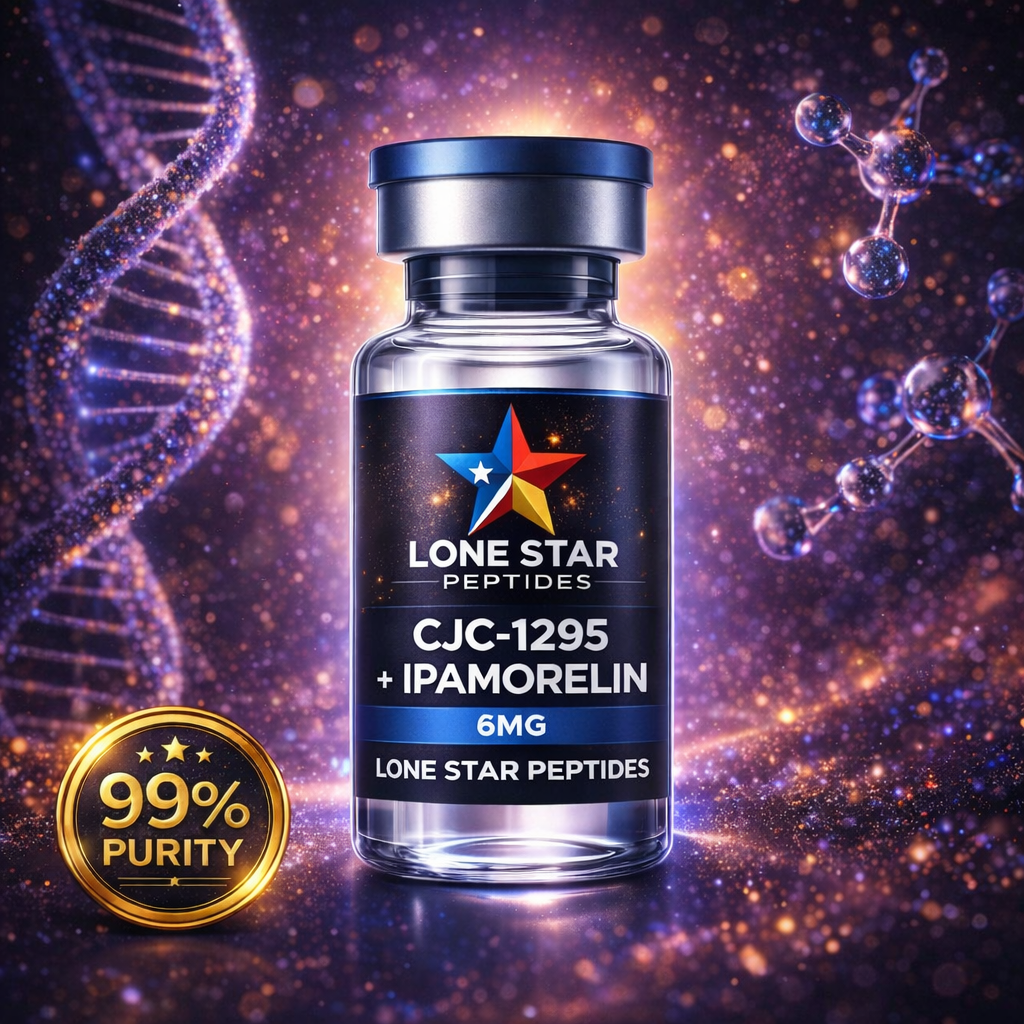
What is CJC‑1295 with DAC?
CJC‑1295 is a 30‑residue tetrasubstituted GHRH(1–29) analog developed by ConjuChem. The “DAC” variant carries a maleimidopropionyl‑Lys linker that covalently binds circulating serum albumin, producing a dramatically extended half‑life compared with native GHRH or sermorelin. In published research, single subcutaneous doses raised mean GH and IGF‑1 for up to 7–11 days.
Mechanism of Action
- GHRH‑receptor (GHRHR) agonist on pituitary somatotrophs
- DAC maleimide forms a covalent Michael adduct with Cys‑34 of serum albumin, protecting the peptide from DPP‑IV degradation and renal clearance
- Half‑life extended to ~6–8 days, producing a sustained “GH bleed” rather than pulsatile release
- Downstream elevation in hepatic IGF‑1 across multiple days post‑dose
Compound Properties
- Molecular formula: C165H269N47O46
- Molecular weight: ~3647.2 g/mol
- CAS: 863288‑34‑0
- Sequence: Tyr‑D‑Ala‑Asp‑Ala‑Ile‑Phe‑Thr‑Gln‑Ser‑Tyr‑Arg‑Lys‑Val‑Leu‑Ala‑Gln‑Leu‑Ser‑Ala‑Arg‑Lys‑Leu‑Leu‑Gln‑Asp‑Ile‑Leu‑Ser‑Arg‑Lys(MPA)‑NH₂
- Form: Lyophilized powder
- Unit size: 5 mg / vial
- Source: Solid‑phase peptide synthesis; ≥99% purity by HPLC
Research‑Reference Dosing
Published research‑reference ranges in clinical literature:
- Teichman et al., Journal of Clinical Endocrinology & Metabolism (2006): single‑dose, dose‑escalation study in healthy adults (30–250 µg/kg SC). Mean GH increased 2–10‑fold and IGF‑1 1.5–3‑fold, with effects persisting up to 11 days at higher doses.
- Ionescu & Frohman, JCEM (2006): pulsatility analysis showing preserved GH pulsatility on the raised baseline.
Research Findings
- Sustained elevation of GH and IGF‑1 across multi‑day windows from a single SC dose (Teichman 2006)
- Preserved GH pulsatility on an elevated baseline (Ionescu 2006)
- Clinical development ultimately halted after a Phase 2 cardiac death in a separate program; causality debated in the literature
Known Side Effects Reported in Research/Trials
- Injection‑site reactions, flushing, headache
- Transient tachycardia or palpitations at higher doses
- Potential water retention, arthralgia, paresthesias (class‑typical of sustained GH/IGF‑1 elevation)
- Long‑term safety data in humans is limited; one unexplained cardiac event in a related Phase 2 trial has been reported
Storage & Handling
- Lyophilized (unreconstituted) vials: store at −20°C long‑term; short‑term 2–8°C acceptable.
- After reconstitution with bacteriostatic or sterile water: store at 2–8°C; use within 14–28 days per standard peptide stability guidance.
- Protect from light, heat, and repeated freeze‑thaw cycles. Handle in a sterile laboratory environment.
Certificate of Analysis
A Certificate of Analysis (COA) confirming identity and purity by HPLC / MS is available upon request. Contact Lonestar Peptides for lot‑specific documentation.
Summaries reference peer‑reviewed preclinical and clinical literature available as of early 2025. Newer findings may not be reflected. Researchers should consult current literature and conduct their own due diligence. Lonestar Peptides makes no claim of therapeutic benefit.